verizon vs att is the most critical decision mobile consumers face in 2026 when choosing a reliable telecom provider.
As the telecommunications landscape continues to evolve, the battle of verizon vs att has shifted from basic 4G LTE coverage to advanced 5G ultra-wideband capabilities, satellite connectivity, and AI-driven network management.
Choosing between these two telecom giants requires a deep dive into your specific needs, geographic location, data habits, and budget requirements.
This comprehensive, E-E-A-T driven guide explores every facet of the verizon vs att rivalry to help you make the best choice for your personal or business mobile needs.
Contents
The Current State of verizon vs att in 2026
When analyzing verizon vs att today, it is essential to look beyond the marketing hype and focus on real-world performance metrics.
Both carriers have spent billions over the past few years acquiring C-band spectrum to bolster their mid-band 5G networks.
The result is a highly competitive market where the verizon vs att dynamic often comes down to hyper-local coverage rather than a clear national winner.
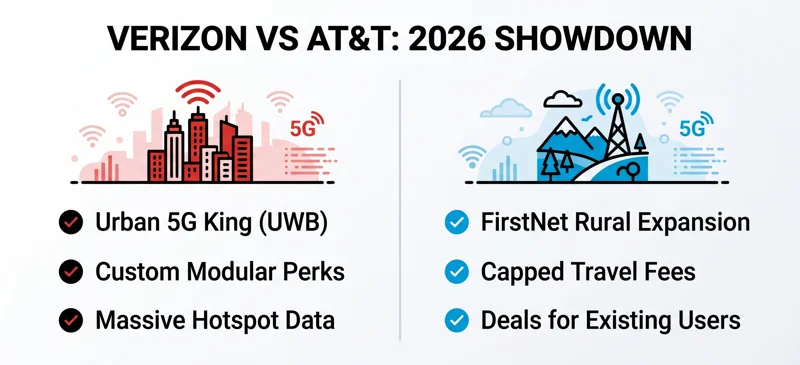
Verizon continues to market itself as the king of reliability, relying on its dense network of small cells in urban environments.
AT&T, on the other hand, leans heavily into its FirstNet infrastructure, providing incredibly robust and resilient coverage that spans both rural and urban areas.
verizon vs att: 5G Speed and Network Performance
When comparing 5G speeds in the verizon vs att debate, the differences are nuanced but significant.
Verizon’s 5G Ultra Wideband (UWB) network offers staggering download speeds, often exceeding 1 Gbps in major metropolitan areas, stadiums, and airports.
AT&T’s 5G+ network is equally impressive, utilizing both mmWave and mid-band spectrum to deliver consistent, high-speed data to its users.
However, AT&T often edges out Verizon in overall 5G availability, meaning users spend more time connected to a 5G signal rather than dropping back to LTE.
| Network Metric (2026) | Verizon Performance | AT&T Performance |
|---|---|---|
| Average 5G Download Speed | 245 Mbps | 220 Mbps |
| 5G Availability (Time Connected) | 58% | 64% |
| Video Streaming Quality | Excellent (Up to 4K on premium) | Excellent (Up to 4K on premium) |
| Network Latency (Ping) | 28 ms | 31 ms |
“The defining factor in the verizon vs att speed race is no longer who has the highest peak speed, but who provides the most consistent mid-band connection throughout the user’s daily commute.”
Pricing Breakdown: verizon vs att Unlimited Plans
Pricing is often the deciding factor for consumers weighing verizon vs att.
In 2026, both carriers have simplified their core plan offerings, but the base prices remain premium compared to MVNOs (Mobile Virtual Network Operators).
The verizon vs att pricing war generally centers around multi-line family discounts, auto-pay requirements, and bundled entertainment perks.
Verizon’s “myPlan” structure allows users to pay a base rate for network access and then add specific “perks” for an additional flat fee per month.
AT&T takes a more traditional approach with its “Unlimited Your Way” plans, baking hotspot data and security features directly into different pricing tiers.
verizon vs att: Which Offers Better Value?
Determining the better value in the verizon vs att comparison depends heavily on how many lines you need.
For single-line users, AT&T often comes out slightly cheaper on its entry-level unlimited plan.
However, Verizon’s modular perk system means you are not paying for streaming services you do not use, potentially saving you money if you only want the network connection.
| Single Line Plan Tier | Verizon Price (Auto-Pay) | AT&T Price (Auto-Pay) |
|---|---|---|
| Entry-Level Unlimited | $65 / month | $60 / month |
| Mid-Tier Unlimited (with Hotspot) | $80 / month | $75 / month |
| Premium Unlimited (No Deprioritization) | $90 / month | $85 / month |
Coverage Face-Off: verizon vs att in Rural America
One of the most heavily debated topics in the verizon vs att conversation is rural coverage.
Historically, Verizon was the undisputed champion of rural America, offering a signal in places where other carriers went entirely dead.
In 2026, the verizon vs att rural dynamic has shifted dramatically thanks to AT&T’s FirstNet contract with the federal government.
Building out a network for first responders required AT&T to erect new cell towers in deeply underserved rural and mountainous regions.
As a result, AT&T’s total square mileage of coverage has grown immensely, challenging Verizon’s historical dominance in rural and highway connectivity.
verizon vs att: Dead Zones and Building Penetration
Network reliability indoors is another crucial factor when comparing verizon vs att.
Verizon’s reliance on certain frequency bands gives it excellent building penetration, meaning fewer dropped calls in large office buildings or deep basements.
AT&T also performs exceptionally well indoors, utilizing low-band 5G to ensure a signal reaches through thick concrete and steel.
To verify the exact coverage at your home address, you should always consult official mapping data rather than carrier marketing materials.
You can view unbiased coverage metrics on the Federal Communications Commission (FCC) National Broadband Map.
| Coverage Aspect | Verizon Strength | AT&T Strength |
|---|---|---|
| Overall Square Mileage | Excellent | Industry Leading (via FirstNet) |
| Urban Density | Industry Leading (UWB Small Cells) | Excellent |
| Rural Highways | Highly Reliable | Highly Reliable |
“The gap in rural coverage has closed significantly by 2026; the verizon vs att debate now centers on localized tower placement rather than national geographic dominance.”
Entertainment Perks and Add-ons: verizon vs att
The modern verizon vs att comparison must account for the streaming perks and digital subscriptions bundled with mobile plans.
As previously mentioned, Verizon unbundled its perks, meaning you no longer get the Disney Bundle automatically included for free.
Instead, Verizon offers these perks for a flat discounted rate (typically around $10 per perk), which includes options like Apple One, Netflix & Max bundles, and Walmart+.
AT&T, conversely, has largely stepped away from offering free streaming services to new customers, focusing its value proposition on hotspot data and roaming features.
verizon vs att: Mobile Hotspot Allowances
If you work remotely or travel frequently, mobile hotspot data is a critical battleground in the verizon vs att comparison.
Verizon’s premium plans offer massive amounts of high-speed mobile hotspot data, often reaching up to 130GB per month before throttling to 3 Mbps.
AT&T’s premium “Unlimited Premium PL” plan also offers substantial hotspot data, typically around 60GB, which is sufficient for most travelers but less than Verizon’s top tier.
| Hotspot & Perks (Premium Plans) | Verizon Unlimited Ultimate | AT&T Unlimited Premium |
|---|---|---|
| High-Speed Hotspot Data | 60GB included (up to 100GB+ with add-ons) | 60GB included |
| Entertainment Perks | Available as $10 add-ons | None included |
| Cloud Storage | Available via add-on | Not included |
International Roaming and Travel: verizon vs att
For the globetrotter, evaluating verizon vs att requires looking at international roaming policies.
Both carriers offer excellent coverage in Mexico and Canada, typically including unlimited talk, text, and data in these countries on their mid-to-high tier plans.
For overseas travel, the verizon vs att strategies diverge slightly in structure and pricing.
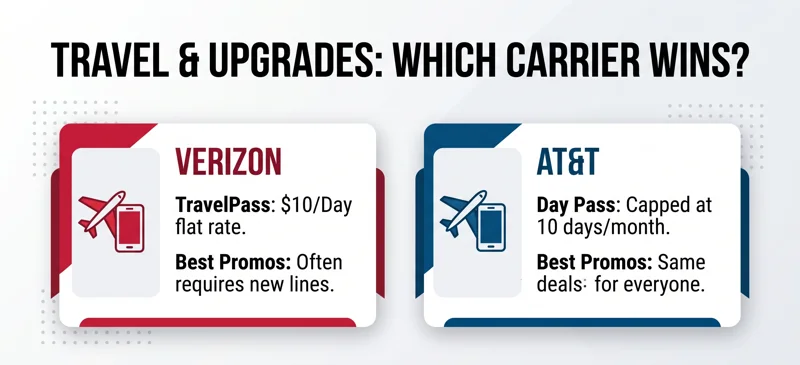
Verizon’s TravelPass charges a flat daily fee (around $10/day) to use your domestic plan allowances abroad in over 210 countries.
AT&T’s International Day Pass operates similarly at $12/day, but it smartly caps the charges at 10 days per billing cycle, meaning you never pay more than $120 extra for a long trip.
verizon vs att: High-Speed International Data Limits
Another point in the verizon vs att international debate is how they handle data throttling abroad.
Verizon recently upgraded its premium “Unlimited Ultimate” plan to include high-speed international data built directly into the monthly cost without daily fees.
AT&T relies heavily on its Day Pass, but the key advantage is that it offers truly unlimited high-speed data while roaming, whereas Verizon’s daily pass throttles you after a few gigabytes per day.
“For extended international vacations exceeding two weeks, AT&T’s billing cap makes it the superior choice over Verizon’s traditional daily charge model.”
Customer Service and Satisfaction: verizon vs att
When technology fails, customer support becomes the most vital aspect of the verizon vs att experience.
Historically, telecom customer service is notorious for long wait times and unhelpful automated systems.
In 2026, both carriers have heavily integrated AI chatbots to handle simple account queries, which has reduced call wait times but frustrated users seeking complex human assistance.
Independent industry analysts and consumer satisfaction surveys frequently show a tight race between the two.
Verizon often scores slightly higher in overall customer satisfaction and retail store experience, while AT&T holds a strong reputation for business client support.
verizon vs att: Device Promotions and Upgrades
Customer retention often relies on phone upgrade promotions, a major battleground in the verizon vs att conflict.
Both carriers offer aggressive trade-in deals, often covering the entire cost of a base model iPhone or Samsung Galaxy.
However, AT&T generally offers its best phone deals to both new and existing customers alike, whereas Verizon occasionally restricts its highest trade-in tiers to new customers or those adding a new line.
Furthermore, both carriers now lock you into 36-month installment agreements, meaning your “free” phone requires a three-year commitment.
| Customer Experience & Promos | Verizon | AT&T |
|---|---|---|
| Best Deals For… | New Customers & Line Additions | New & Existing Customers |
| Contract Length (Device Promos) | 36 Months | 36 Months |
| Retail Store Presence | Extensive Nationwide | Extensive Nationwide |
verizon vs att: The Final Verdict for 2026
Concluding the verizon vs att debate requires acknowledging that there is no universal winner; there is only a winner for your specific needs.
Choose Verizon if you live in a major city and can take advantage of their blazing-fast Ultra Wideband 5G network, or if you prefer a modular plan where you control your perk subscriptions.
Choose AT&T if you frequently travel internationally, live in a rural area covered by their FirstNet expansion, or want peace of mind knowing existing customers get the same phone deals as new ones.
In the ongoing saga of verizon vs att, both carriers provide premium, highly reliable service that justifies their tier-one status in the mobile industry.
Read also: the Verizon Unlock Policy
Frequently Asked Questions
Which network is faster in the verizon vs att comparison?
Verizon generally boasts higher peak download speeds in urban areas due to its extensive millimeter-wave network, but AT&T offers highly consistent mid-band 5G speeds across a broader geographic footprint.
Does verizon vs att matter if I am traveling to Europe?
Yes. While both offer daily international passes, AT&T is often preferred for long trips because it caps its International Day Pass charges at 10 days per billing cycle, whereas Verizon’s standard TravelPass charges you for every single day you use it.
Who has better rural coverage, Verizon or AT&T?
Historically Verizon was the rural king, but by 2026, AT&T’s FirstNet expansion has dramatically increased its rural and remote coverage, making them extremely competitive and often superior in certain rural counties.
Are Verizon plans more expensive than AT&T plans?
Generally, yes. Verizon’s base plans are often a few dollars more expensive than AT&T’s equivalent tiers, especially when you factor in taxes and Verizon’s optional perk add-ons.
Do both carriers lock you into 3-year contracts for free phones?
Yes. Neither carrier uses traditional service contracts anymore, but they both utilize 36-month device installment plans. If you leave the carrier before the 36 months are up, you lose your promotional credits and owe the remaining balance on the phone.
Which carrier is better for mobile hotspot usage?
Verizon is slightly better for heavy hotspot users because they offer plan add-ons that can push your high-speed mobile hotspot data allowance well over 100GB per month.
In the verizon vs att debate, who has better customer service?
Customer service is highly subjective and varies by region, but independent consumer reports often give Verizon a slight edge in retail store experience and network troubleshooting resolution.
Disclaimer: This article is for informational purposes only. Carrier pricing, plan details, coverage maps, and promotional offers are subject to change by the respective companies without notice. Always verify current information directly with Verizon or AT&T before signing an agreement.