The people who only need four hours sleep have always fascinated scientists, medical professionals, and their chronically exhausted peers alike. For the vast majority of the global population, getting less than seven hours of rest feels like a physical and mental burden. However, there is a rare subset of individuals who naturally wake up before dawn, fully energized, and ready to tackle the day with zero caffeine.
For as long as she can remember, Aimee Pugh Bernard has been one of the people who only need four hours sleep. Today, she tends to go to bed around 22:00 and is wide awake by 04:30. Often, she logs just five hours of slumber, yet she remains highly productive.
Before 08:00 AM, she walks her dog, completes a rigorous one-hour gym session, and finishes an hour and a half of work. Friends gawk at her ability to do so much on so little sleep, but in her family, this trait is entirely normal. Her father and brother share the exact same boundless energy.
Contents
The Science Behind The People Who Only Need Four Hours Sleep
Most of us require significantly more rest. According to official guidelines, the average adult aged 26 to 64 needs about seven to nine hours of sleep in every 24-hour cycle to maintain optimal health. For decades, scientists wondered why there is such a wide variation in how much rest different individuals require.
Recently, scientists have pinpointed how genetics play a massive role in sleep duration. The people who only need four hours sleep often carry rare, inherited genetic mutations. In 2019, a research team from the University of California, San Francisco discovered a specific genetic mutation directly related to human sleep duration.
People carrying this mutation generally go to bed at conventional times but wake up very early. They often get anywhere from four to six and a half hours of sleep per night without any negative side effects. After testing her blood, Bernard discovered she carried this exact mutation.
Understanding Familial Natural Short Sleep (FNSS)
This rare, heritable condition is known in the medical community as Familial Natural Short Sleep (FNSS). Since the initial discovery, scientists have identified several other mutations associated with FNSS. The biggest mystery surrounding the people who only need four hours sleep is how their bodies manage to avoid the usual cognitive decline associated with sleep deprivation.
“You become progressively more impaired by lack of sleep, but also increasingly unaware of that impairment—unless you possess the rare FNSS genetic mutation.”
There is intriguing evidence suggesting that FNSS-linked genetic variations do more than just cause short sleep. They might actually protect those who have the mutation from the severe health consequences of sleep deprivation, such as memory impairment and cardiovascular stress.
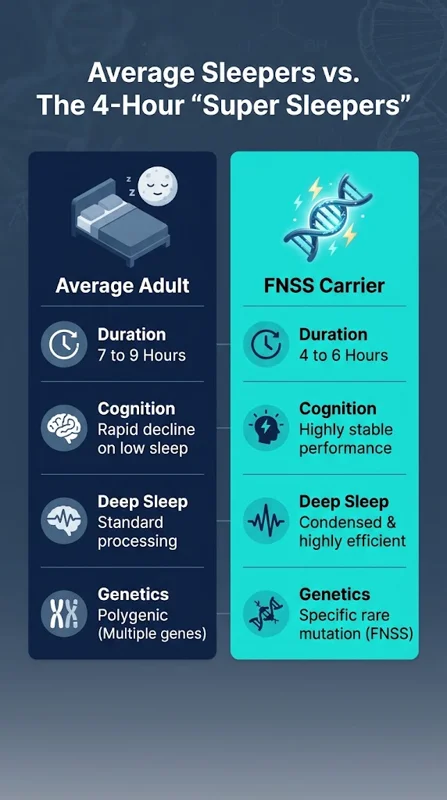
To highlight the differences between average sleepers and those with FNSS, let us look at the following comparison table:
| Feature | Average Adult Sleepers | Individuals with FNSS |
|---|---|---|
| Required Sleep Duration | 7 to 9 hours | 4 to 6 hours |
| Cognitive Performance on Low Sleep | Rapidly declines | Remains highly stable |
| Deep (Non-REM) Sleep Efficiency | Standard processing | Highly condensed and efficient |
| Genetic Heritability | Polygenic (multiple genes) | Specific rare mutations |
Genetic Mutations Found In The People Who Only Need Four Hours Sleep
Molecular biologists are working hard to figure out exactly why the people who only need four hours sleep seem so perfectly fine. One 2019 experiment introduced an FNSS-linked mutation into mice. The researchers found that the mice with this variant slept less but were completely protected from memory deficits.
In fact, another groundbreaking test revealed that mice with some of these genetic variants were actually less likely to develop the animal equivalent of Alzheimer’s disease. This suggests that the genetic mutation provides a profound neuroprotective effect.
The Famous Twin Study on Short Sleep Duration Genetics
In 2014, an international research team investigated a pair of human fraternal twins. One twin had the short-sleep mutation, and the other did not. Researchers found that the carrier twin consistently slept about an hour less than his sibling every night.
When the researchers kept both twins awake continuously for 38 hours, the results were staggering. The twin carrying the mutation had 40% fewer performance lapses than his brother. Even more fascinating was their brain activity during rest. Even though the carrier slept less, he obtained the same amount of non-REM “deep” sleep as his brother.
This essentially means that the people who only need four hours sleep are highly efficient sleepers. They get all the physical and psychological benefits of deep rest in a much shorter window of time. For more general guidelines on healthy rest, you can read the recommendations from the National Sleep Foundation.
Health Consequences and The People Who Only Need Four Hours Sleep
Within the pharmaceutical industry, there is an intense interest in the people who only need four hours sleep. Scientists hope that discoveries about short sleepers could eventually lead to drugs for treating severe sleep disorders. There is even talk of helping military personnel safely get by on less rest during critical missions.
However, scientists must proceed with extreme caution. They need a clear understanding of whether these variants protect short sleepers from negative consequences long-term. You cannot simply create a drug that reduces sleep without understanding the potential risks of developing neurodegenerative diseases a decade later.
“You don’t want to sleep less and then get Alzheimer’s or Parkinson’s or cancer after 10 years, or five years, or 20 years. Understanding the exact mechanism is critical.”
While FNSS mutations are extreme, overall sleep duration is estimated to be anywhere from 30% to 65% heritable. Hundreds of different parts of the human genome influence how long we need to rest. If you took any single common mutation on its own, it would only account for a difference of about one minute of sleep.
Are There Hidden Risks for the Average Person?
When the people who only need four hours sleep naturally follow their biological rhythm, they thrive. But what happens when an average person tries to force a four-hour sleep schedule? The results are usually disastrous. Research shows that common genetic variants associated with shorter sleep in average people actually link to a higher risk of insomnia.
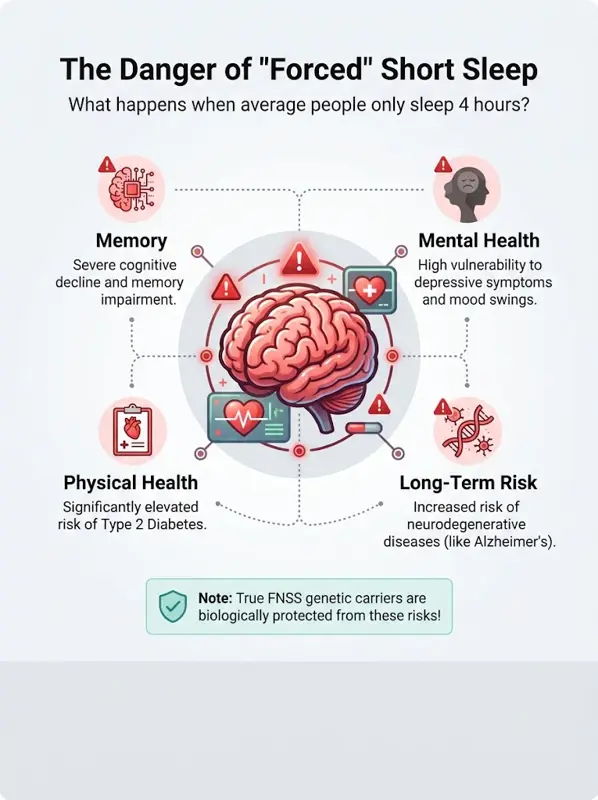
Here is a breakdown of how genetic sleep traits impact overall physical and mental health:
| Health Condition | Impact on True FNSS Carriers | Impact on Average Individuals (Forced Short Sleep) |
|---|---|---|
| Memory Impairment | Highly Protected | Severe Decline |
| Type 2 Diabetes Risk | No increased risk | Significantly Elevated |
| Depressive Symptoms | Stable Mood | High Vulnerability |
| Alzheimer’s Disease | Potential Resistance | Increased Risk over time |
The Illusion of Rest: Why Most Are Not The People Who Only Need Four Hours Sleep
Making matters more complicated, even those of us who think we function fine on little rest are not always the best judges of our own cognitive state. Studies have shown that when healthy adults are curtailed to just four hours in bed per night, their performance on cognitive tests worsens daily.
Yet, surprisingly, participants rate themselves as feeling only “slightly” sleepy. Sleep scientists note that as you become progressively more impaired by exhaustion, you also become increasingly unaware of that impairment. This is the danger of assuming you are one of the people who only need four hours sleep when you actually are not.
In a fascinating recent study, scientists looked at 343 women with bipolar disorder who had just given birth. Those whose genetics scored them as most likely to be natural short sleepers had half the risk of developing postpartum psychosis compared to those who needed standard sleep.
This suggests that true genetic short sleepers develop a high tolerance to sleep disruption early in life. This resilience mitigates the severe impact of disrupted sleep on their mood during stressful periods like the postnatal phase.
Embracing Your Natural Biological Clock
Over the long term, genetic findings will help pinpoint which individuals truly belong to the people who only need four hours sleep. These discoveries will eventually sift out those who merely feel fine from those who are genuinely protected by their DNA.
For individuals like Aimee Pugh Bernard, learning she carried the FNSS mutation took a massive amount of pressure off her shoulders. She no longer wonders if she is bad at relaxing or juggling too much in her daily life.
Understanding that this trait is etched into her genetics allows her to embrace her early mornings without guilt. Until science creates a magic pill, the rest of us must accept our biological need for seven to nine hours of quality rest every night.
Frequently Asked Questions
Who exactly are the people who only need four hours sleep?
They are individuals possessing a rare genetic mutation known as Familial Natural Short Sleep (FNSS), which allows them to function optimally on 4 to 6 hours of rest.
Is it possible to train myself to be one of the people who only need four hours sleep?
No. While you can force yourself to sleep less, your cognitive and physical health will decline. True short sleepers have a genetic neuroprotective advantage.
What is Familial Natural Short Sleep (FNSS)?
FNSS is a heritable genetic condition where individuals naturally require significantly less sleep than the average person without suffering any negative health consequences.
Do short sleepers get less deep sleep than normal sleepers?
Surprisingly, no. Studies show that individuals with FNSS get the same amount of restorative, non-REM deep sleep in a much shorter, highly efficient timeframe.
Can forcing a short sleep schedule cause health problems for average people?
Yes. Chronic sleep deprivation in average individuals is heavily linked to memory impairment, type 2 diabetes, depression, and an increased risk of Alzheimer’s disease.
Why do I feel fine even though I only sleep 5 hours a night?
Science calls this the “illusion of rest.” As you become more cognitively impaired from lack of sleep, your brain loses its ability to accurately judge its own level of impairment.
Will there ever be a drug that lets normal people sleep only four hours safely?
Pharmaceutical companies are actively studying FNSS genetics to develop such drugs, but it remains a distant future goal, as researchers must ensure long-term side effects like neurodegeneration are avoided.
Disclaimer: This article is for informational purposes only and is not intended to be a substitute for professional medical advice, diagnosis, or treatment. Always seek the advice of your physician or other qualified health provider with any questions you may have regarding a medical condition.