Receiving a 41599 text message t mobile alert on your phone can understandably cause a moment of confusion. You might be wondering if it is an urgent alert regarding your cellular bill or a potential scam trying to steal your personal information. In 2026, mobile security is more critical than ever, and understanding exactly who is texting you is the first line of defense.
This comprehensive guide will unpack the mystery behind the 41599 number. We will explore why you are receiving these messages, what they typically contain, and how to manage your carrier communication preferences effectively.
Whether you are a new customer or have been on the network for years, decoding every 41599 text is essential. By the end of this article, you will know exactly how to handle these automated messages safely and securely.
Contents
What Exactly is the 41599 Text Message T Mobile?
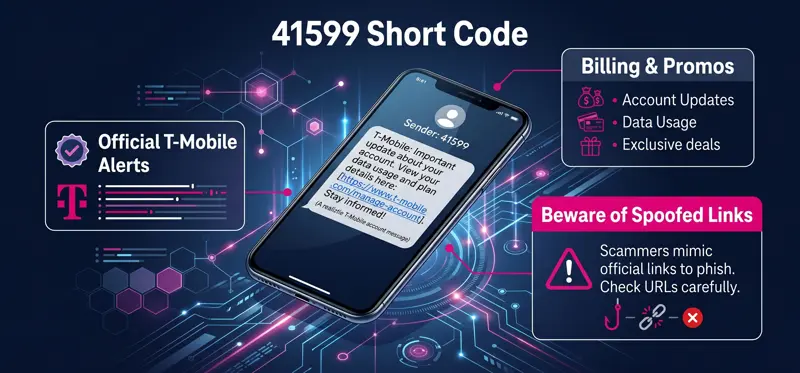
To put it simply, a 41599 short code text message is an automated SMS sent through a system utilized by T-Mobile. Telecommunications companies use short codes—usually five or six digits long—to send high-volume, automated text messages to their subscribers.
Unlike standard ten-digit phone numbers, short codes are approved by mobile carriers for commercial and administrative use. They are designed to process thousands of messages per second, making them ideal for massive carrier updates.
When you receive a text from 41599, it is generally an administrative or marketing message generated directly by T-Mobile’s backend CRM (Customer Relationship Management) system. It is not a text from an individual human representative.
Common Reasons for Receiving a Text from 41599
T-Mobile uses this specific channel for several distinct communication categories. Understanding these categories can help you determine the urgency of the message.
One of the primary uses for the 41599 short code is account administration. The carrier will proactively notify you of important changes to your monthly billing cycle, payment processing confirmations, or approaching data limits.
Additionally, T-Mobile leans heavily on this number for promotional marketing. If the carrier launches a new smartphone upgrade deal, a discounted family plan, or a special perk through the T-Mobile Tuesdays program, you might receive a notification.
| Message Category | Typical Content | Urgency Level |
|---|---|---|
| Billing & Payments | Auto-pay confirmations, past due alerts, bill availability. | High |
| Service Updates | Network maintenance in your area, outage resolutions. | Medium |
| Marketing & Promos | New device launches, accessory discounts, plan upgrades. | Low |
| Account Security | Password change alerts, SIM swap notifications. | Critical |
Is the 41599 Text Safe, or Is It a Scam?
The core short code itself is a legitimate T-Mobile asset. However, the telecommunications landscape in 2026 is fraught with sophisticated phishing attempts known as “smishing” (SMS phishing).
Scammers use advanced software to “spoof” sender IDs. This means a malicious actor could theoretically send you a text message that appears to come from 41599, even though it did not originate from T-Mobile’s actual servers.
Therefore, while the short code is official, you must evaluate the context of every single message. Legitimate T-Mobile messages will never ask you to reply directly with your social security number, account PIN, or full credit card details.
Always exercise extreme caution with any text message containing a hyperlink. Do not click links claiming your account is suspended unless you can independently verify it through the official carrier app.
How to Spot a Fake 41599 Short Code Text Message
Distinguishing between an authentic carrier alert and a dangerous scam requires a keen eye. Scammers prey on urgency and fear, hoping you will act before thinking.
A legitimate text from T-Mobile will generally address you by name or reference the last four digits of your specific account number. It will use professional grammar and formatting.
Conversely, fake messages often contain glaring typos, strange capitalization, or generic greetings like “Dear Customer.” The most massive red flag is the URL included in the message. If the link directs you to a suspicious domain instead of the official T-Mobile website, it is undoubtedly a scam.
| Indicator | Legitimate T-Mobile Text | Scam / Spoofed Text |
|---|---|---|
| Tone | Informational and professional. | Urgent, threatening account closure. |
| Links | Starts with exactly “https://t-mobile.com/…” | Uses bit.ly, tinyurl, or misspellings (t-mobille.com). |
| Information Request | Directs you to log into your app securely. | Asks for passwords or PINs directly in the chat. |
| Grammar | Flawless corporate communication. | Contains typos or awkward phrasing. |
Why Did You Start Receiving These Texts Now?
If you have never received a text from 41599 before and suddenly started getting them, there are a few logical explanations. The most common reason is a recent change to your account status.
Perhaps you recently upgraded your phone, changed your billing plan, or opted into a new promotional campaign. Engaging with T-Mobile customer service can sometimes reset your communication preferences, automatically opting you back into marketing messages.
Another frequent scenario involves recycled phone numbers. If you recently acquired a new phone line, the previous owner of that specific number might have been an active T-Mobile subscriber who opted into various alert programs.
The Evolution of Carrier Messaging Protocols
The telecommunications industry is constantly evolving. In recent years, carriers have begun shifting from traditional SMS to RCS (Rich Communication Services).
While standard short codes like 41599 still rely on basic SMS protocols, the future promises more secure communication methods. RCS allows companies to verify their identity, placing a verified checkmark next to their name in your messaging app.
Until these verified sender profiles become globally standardized across all devices, users must remain vigilant and manually verify the integrity of the short codes texting them.
Always utilize the official carrier application on your smartphone to check your billing and account status, rather than relying solely on automated text message alerts.
How to Stop the 41599 Text Message T Mobile
If you find these automated messages annoying and disruptive, you have full control to stop them. Federal regulations require companies to provide a simple opt-out mechanism for automated commercial texts.
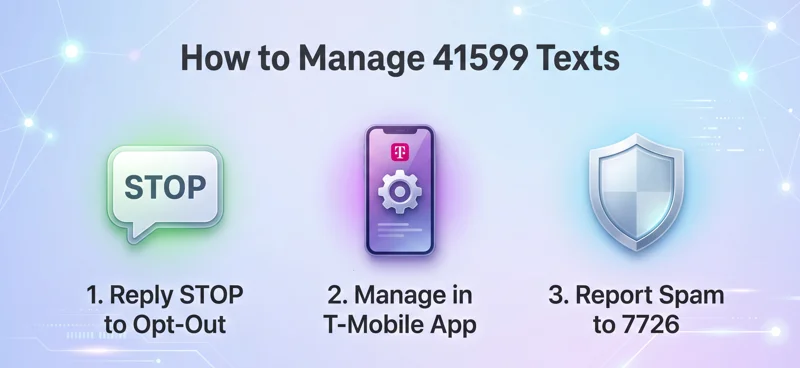
The easiest and fastest method is to reply directly to the message thread. Open the 41599 text and reply with the single word “STOP”. The system should process your request and immediately send a confirmation text stating you have been unsubscribed.
Keep in mind that replying “STOP” generally only unsubscribes you from marketing and promotional texts. You may still receive critical, legally required notifications regarding billing or severe network outages.
| Action Desired | Command to Text to 41599 | Expected Result |
|---|---|---|
| Opt-Out Completely | STOP | Cancels all non-essential marketing subscriptions. |
| Get Assistance | HELP | Receives a message detailing the short code’s purpose and support links. |
| Opt-In Again | START or UNSTOP | Re-subscribes you to the automated alert system. |
Managing Notifications via the T-Mobile App
If texting “STOP” does not resolve the issue, or if you want granular control over exactly which types of alerts you receive, you should use the official mobile application.
Download or open the T-Mobile app on your smartphone. Log in using your primary account credentials. This ensures you have administrative access to change communication preferences for all lines on your account.
Navigate to the “Account” tab, find the “Profile Settings,” and look for “Notifications” or “Communication Preferences.” Here, you can toggle off specific categories like “Special Offers” while leaving “Billing Alerts” active.
Alternative Methods for Blocking Short Codes
Sometimes, carrier backend systems encounter glitches, and the “STOP” command fails to register. If you are continually bombarded by an unresponsive short code, you can use your smartphone’s built-in blocking features.
On both iOS and Android devices, you can open the message thread, tap on the sender’s profile or the number at the top of the screen, and select “Block this Caller” or “Block and Report Spam.”
This method prevents the message from ever reaching your inbox, though it is a localized block on your specific device rather than a network-level unsubscription.
Reporting Suspicious Carrier Texts
If you determine that the message you received from 41599 is a spoofed scam attempt, do not just delete it. Reporting it helps cellular networks identify and block malicious routing hubs.
You can forward any suspicious text message to the global spam reporting number: 7726 (which spells SPAM on a dialpad). Simply copy the contents of the fake text and send it to 7726.
Your carrier will reply asking for the number that sent the spam. You can then reply with the spoofed short code to log it in their security database.
| Method | Steps Required | Effectiveness |
|---|---|---|
| App Settings | T-Mobile App > Profile > Notifications > Toggle Off. | High (Network Level) |
| Device Block | Open message > Info > Block Contact. | Medium (Device Level Only) |
| Spam Reporting | Forward message to 7726. | High (Helps global security) |
| Customer Care | Call 611 and request a marketing block. | High (Permanent Account Level) |
The Importance of Digital Literacy in 2026
Understanding how your mobile carrier communicates with you is a crucial aspect of modern digital literacy. As automation increases, carriers rely less on phone calls and more on text-based systems.
By familiarizing yourself with authorized short codes like 41599, you build a mental whitelist of trusted communication channels. This prevents panic when automated alerts arrive.
Always maintain a healthy skepticism. Never provide sensitive information directly through a text thread. For ultimate security, verify all account alerts by visiting the Official T-Mobile Support Page directly through your web browser.
Frequently Asked Questions
What is a 41599 text message T Mobile?
It is an automated short code used by T-Mobile to send administrative alerts, billing updates, and promotional marketing messages directly to subscribers.
Can I reply to a text from 41599?
You cannot have a conversation with this number, as it is automated. However, you can reply with specific system commands like “STOP” or “HELP”.
Will replying STOP cancel my phone service?
No, replying “STOP” only removes you from the automated marketing text list. It has zero impact on your actual cellular service or billing plan.
Are 41599 short code text messages free to receive?
Yes. T-Mobile does not charge premium messaging fees for receiving their official administrative or promotional alerts.
Why did I get a 41599 text if I use AT&T or Verizon?
If you are not a T-Mobile customer, the message is likely a spoofed spam attempt, or your current phone number previously belonged to a T-Mobile user.
Can scammers hack my phone through a 41599 text?
Simply opening and reading the text cannot hack your phone. However, clicking malicious links within a spoofed text can compromise your data.
How do I know if a 41599 text link is safe to click?
Never trust the link purely based on the sender ID. Log directly into the T-Mobile app or website to verify any claims made in the text message.
Disclaimer: This article is for informational purposes only. Procedures, security policies, and carrier interfaces may change over time. Always consult official T-Mobile documentation or customer support for the most accurate and up-to-date guidance regarding your account security.